The Two-Page Cheatsheet: How I Condense a Course into Two Sheets
A two-page handwritten cheatsheet forces you to compress an entire course into what you actually understand. Here is how I built mine for a deep learning exam and why it worked.
What a Cheatsheet Actually Is
A cheatsheet is not a summary. A summary condenses what someone else wrote. A cheatsheet condenses what you understand well enough to reconstruct under pressure. The difference is meaningful: if you cannot compress something to a single line, you probably do not understand it.
For my deep learning exam at Leuphana, I was allowed two handwritten pages. That constraint was the most useful thing about the exam.
The Structure
The sheet has no fixed layout. Sections are irregular, column widths shift depending on content, and whitespace is used only when nothing else fits. This is intentional. A rigid grid forces everything into equal importance. A flexible grid lets the content determine how much space it deserves.
Conceptually, the two pages follow the arc of the course:
- Initialisation and weight update rules
- Activation functions (sigmoid, tanh, ReLU, ELU, Leaky ReLU, softplus)
- Loss functions (MSE, cross-entropy, log-loss, hinge loss)
- Regularisation (L1, L2, dropout, batch normalisation)
- Forward and backpropagation
- Optimisers (SGD with momentum, Adam)
- Core architectures: feed-forward, CNN, RNN/LSTM, autoencoder, VAE, GAN, normalising flows
Each block reads as a story from left to right: what the thing is, what the constraint is, what the update rule or formula is, and what the edge cases are.
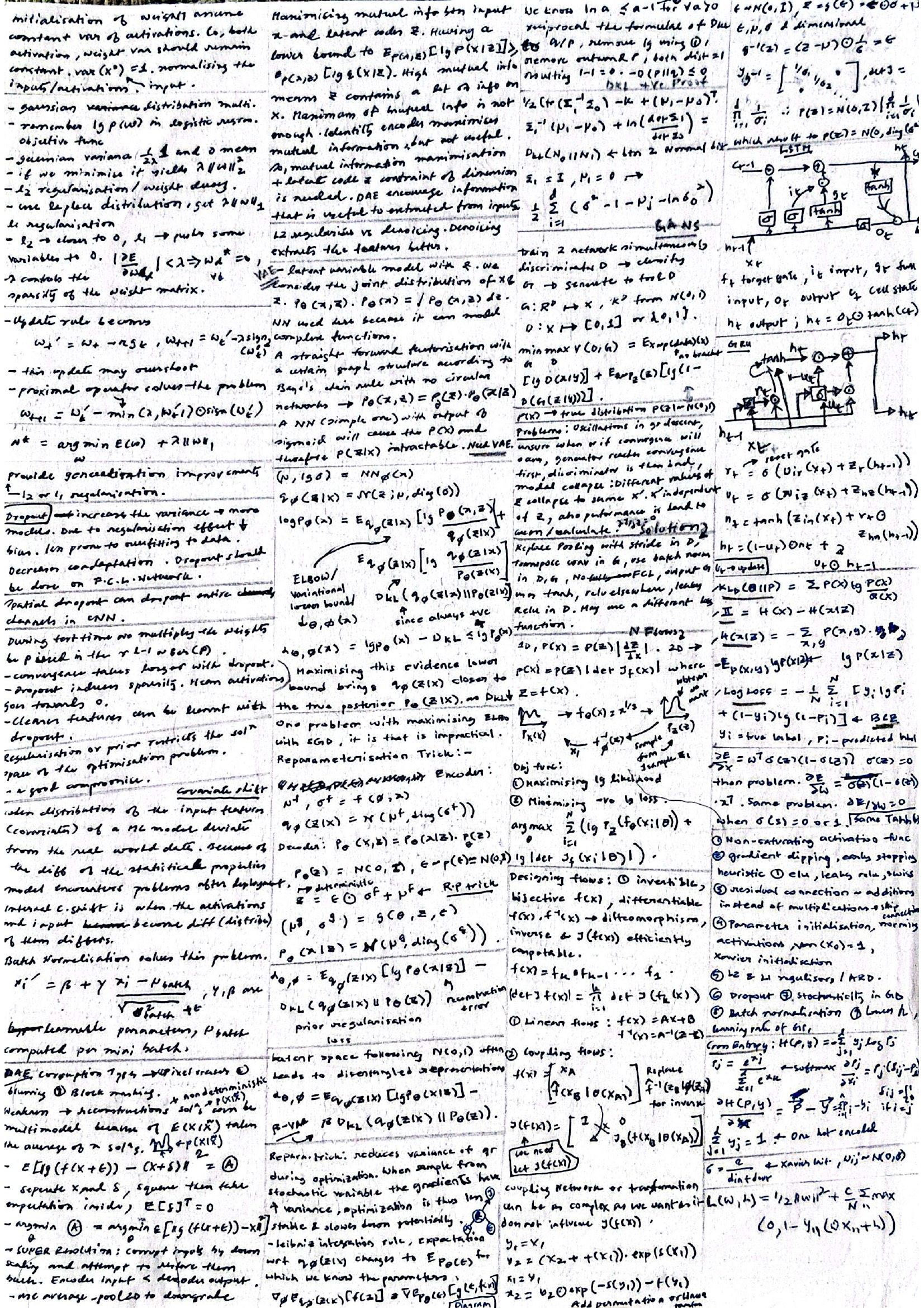
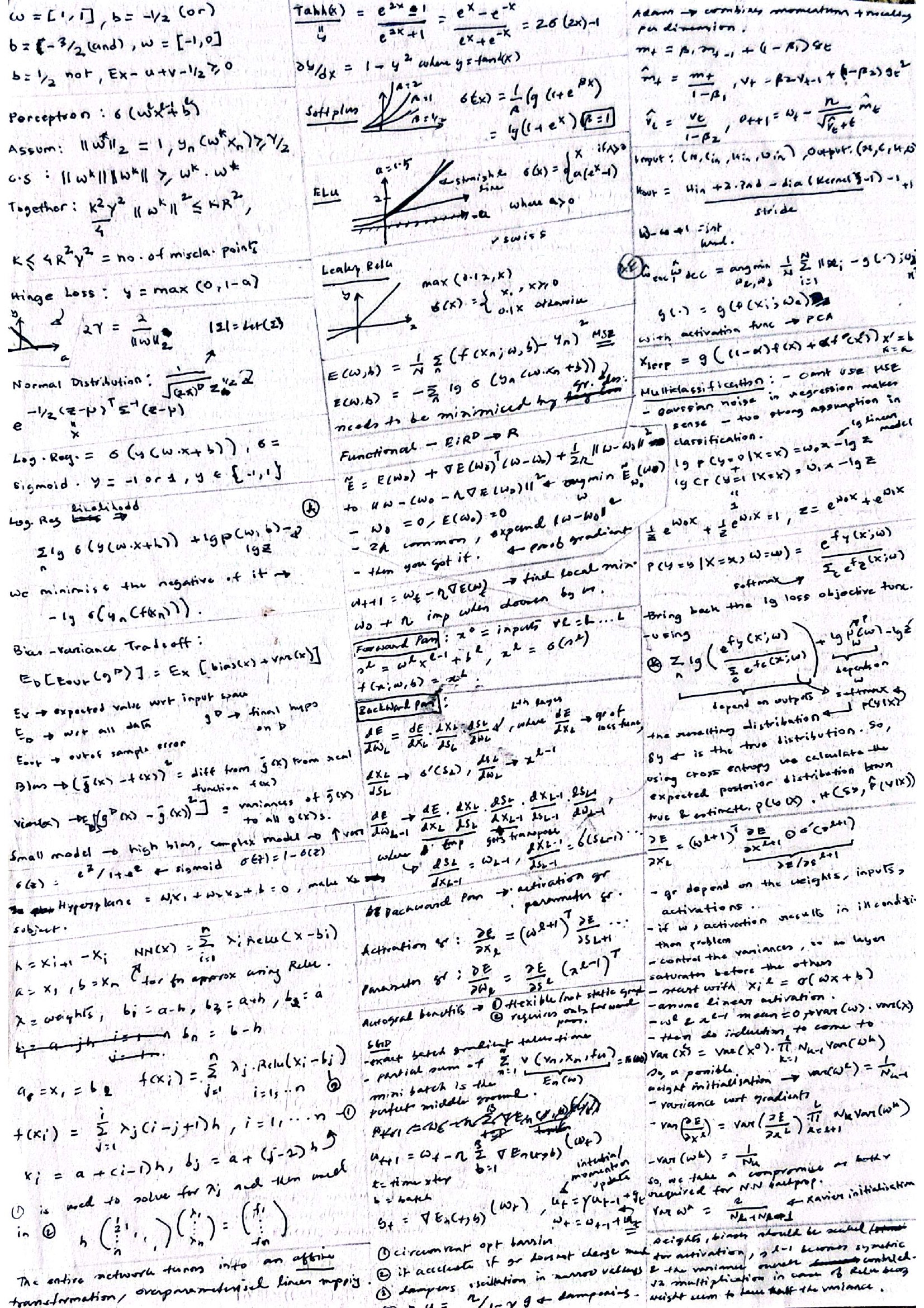
Why Small Handwriting Matters
Smaller handwriting is not about fitting more. It is about slowing you down. When you write small and deliberately, you are forced to decide exactly what to include. The physical act becomes editorial.
The consequence is that every line on the sheet passed through a filter: if I did not understand it well enough to write it in two or three words, I did not write it. If I could not abbreviate it, I did not know it.
Navigation Markers
Getting lost on a dense two-page sheet during an exam is a real problem. I added small bold labels at the start of each section: VAE, GAN, LSTM, Adam. These are not headings in the traditional sense. They are anchor points. You scan the page, find the anchor, and then read the surrounding block.
Before the exam I spent time memorising the spatial layout of the sheets. Not the content, but the position of each section. Top-left of page one: initialisation and update rules. Middle: loss and regularisation. Right column: architectures and flows. This spatial memory means you arrive at the right section in one or two seconds, not twenty.
What I Tried to Externalise
My approach to revision was to move as much recall burden as possible onto the sheets, so my working memory during the exam was free for reasoning. The exam tests whether you can apply knowledge, not recite it. If the formula for the VAE ELBO is on the sheet, I do not need to hold it in my head. I need to understand what it implies.
This is the shift: from memorisation to comprehension. The cheatsheet enables it because it handles the low-level recall.
The Result
I received a 1 (the top grade in the German grading system) in the deep learning course. I am not attributing that entirely to the sheets. The sheet is downstream of understanding. You cannot write a good cheatsheet without first working through the material properly. But the act of building it forces you to find the gaps. If you cannot compress a topic into two lines, you have identified something you need to study further.
If You Build One
A few practical points:
Use a fine-tip pen. 0.3 or 0.4mm. This is what allows the small, legible handwriting.
Write the sheets at least twice. The first draft reveals what you do not understand. The second draft is what you bring to the exam.
Do not copy from slides. Write from memory and check after. This forces encoding.
After you finish the sheets, close them and try to recall the spatial position of five sections. If you cannot, you will waste time during the exam searching.
The sheets do not replace studying. They are the product of studying. If they look dense and complete, you probably did the work. If they look sparse, you have more to do.